
No. 06
Clocks & Pocket Watches
in Pompano Beach
Tall-case, carriage, and marine timepieces.
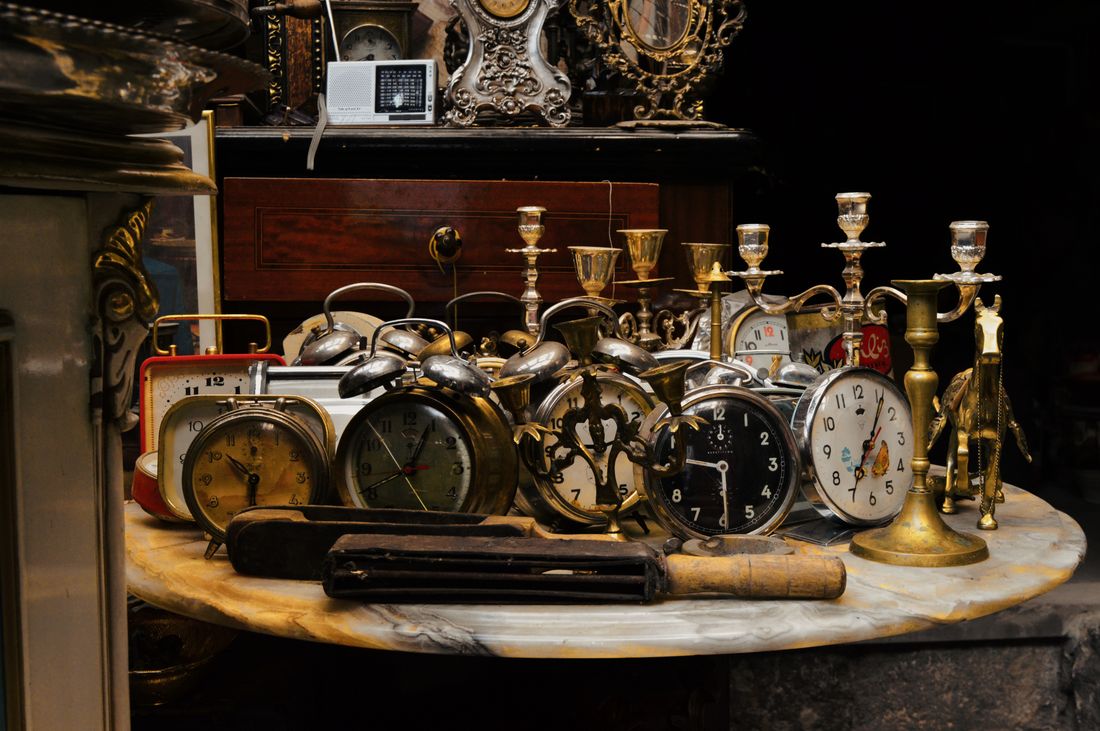
A clock counts the swings of something that swings at a steady rate. You can read most antique clocks by asking three questions: what swings, what pushes it, and what pays for the push. This page covers ship's chronometers, pendulum physics, the history of escapements, and the Connecticut factories that put a clock in nearly every American house. Photograph the dial, the movement and any label or plate before you contact us.
What we look for
- Tall-case (grandfather) and bracket clocks
- French carriage and mantel clocks
- Railroad-grade and complicated pocket watches
- Running or not — condition is factored, not disqualifying
Marine Chronometers: The Sea Clock That Solved Longitude
Pompano Beach sits on a coast where finding your position was once a matter of survival. The object that made it possible still turns up in estates: the marine chronometer. The idea is simple. Earth turns 15° every hour, so a ship carrying the time of its home port can compare that with local noon and read off its longitude. Every four seconds of clock error costs just over one nautical mile of east–west position.
John Harrison's first sea clock, H1, dates to 1735 and sailed to Lisbon aboard HMS Centurion in 1736. Its grasshopper escapement used wooden pallets and needed no oil, a neat answer to lubricants that gummed up at sea. H4, the large pocket-watch design, left Portsmouth aboard HMS Deptford on 18 November 1761 and was about 5 seconds slow on reaching Jamaica, roughly one nautical mile of longitude. A second trial, to Barbados, left it within 39 seconds. Payments from the Board of Longitude and Parliament came in installments, the last £8,750 in 1773.
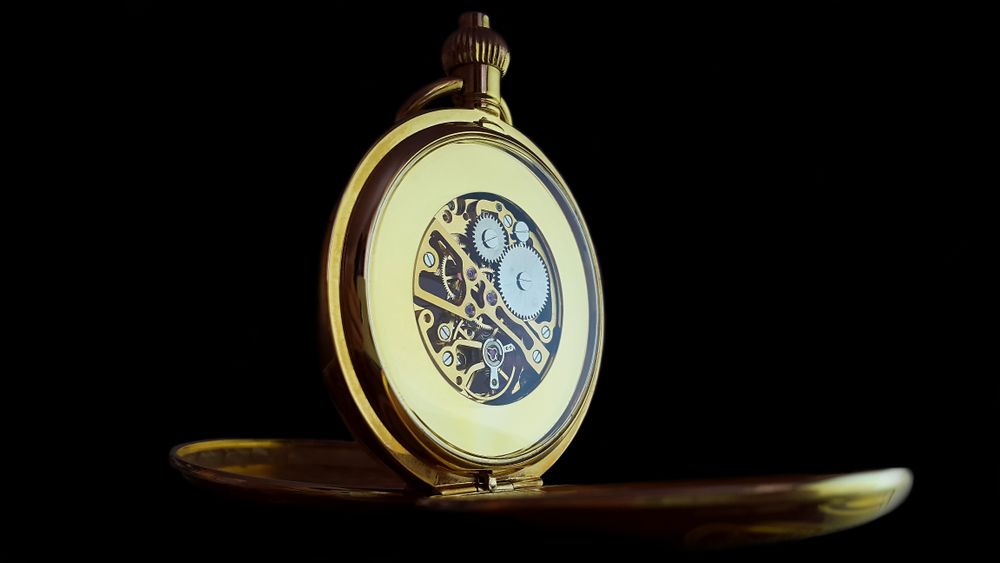
The chronometers you are likely to meet are the later commercial form. Pierre Le Roy's detent escapement (France, 1748) was simplified into the spring detent by Thomas Earnshaw and John Arnold, who patented it in 1780 and moved temperature compensation into a bimetallic balance. A fusee and chain, a cone-shaped pulley driven through a fine chain, evens out the mainspring's changing pull. The whole movement hangs in gimbals inside a wooden box so the dial stays level as the ship rolls. A good mechanical example holds about half a second a day.
What to photograph: the dial signature and serial number, the gimbal ring, any brass plaque on the box lid, and the winding hole. Please do not wind or oil one that has sat idle. Salt air near the Intracoastal is hard on steel parts, so a chronometer from a boating household deserves a specialist's look before anyone tries to start it.
Pendulum Physics: Why a Tall-Case Clock Hides One Metre of Swing
A tall-case clock is a box built to hide a swinging rod. A seconds pendulum, which takes two seconds to swing out and back, has a length of g/π², about 0.9936 m (39.1 in) at standard gravity. Gravity changes with latitude, so at Pompano's roughly 26°N the length works out nearer 0.992 m (our calculation). A clock regulated in a 45°N town and carried to Broward runs about a minute a day slow until the bob is raised, because local gravity is about 0.16% weaker (also calculated).
Galileo's isochronism, the idea that a swing takes the same time whatever its size, holds only for tiny angles. The true period is about T₀(1 + θ₀²/16), with θ₀ the amplitude in radians. A pendulum swinging 3° each side runs about 15 seconds a day slower than the ideal, which is why makers fought for small, steady arcs. The verge's 80–100° swing was hopeless by comparison, and the anchor cut it to roughly 4–6°.
Heat is the other enemy. A steel rod expands about 11.5 parts per million per °C, which costs roughly half a second a day for each degree Celsius. George Graham answered in 1721 with a mercury pendulum, in which a jar of liquid metal rises as the rod lengthens. John Harrison's gridiron of about 1726 used nine rods, five steel and four brass, so their expansions cancel. Either one on a clock marks a serious regulator, not a household timekeeper.
The quality factor, or Q, measures how long a pendulum keeps swinging: energy stored divided by energy lost per cycle. A heavy bob, a clean suspension and little air drag give a high Q, so the escapement's kick disturbs the swing less. That is why old regulators carry such heavy bobs.
Pendulums also influence each other. Huygens noticed in 1665 that two clocks on one beam fell into opposite swings. A recent paper, D'Aniello and Oliveira, "Huygens synchronisation of three clocks equidistant from each other" (arXiv:1905.03534; Nonlinear Dynamics 112, 3303–3317, 2024; DOI 10.1007/s11071-023-09241-9), shows that three identical clocks on one support settle into a phase offset of 2π/3. Two clocks hung on one wall may lock together, so judge each one alone.
Escapements and Connecticut Factories: Dating a Clock
The escapement is the most reliable dating clue on a clock, because each type has its own window.
- Verge: the earliest mechanical escapement, from the 13th century. With a pendulum it swings 80–100°. Original verge-and-foliot clocks are rare because most were rebuilt.
- Anchor: the oldest known example is the Wadham College clock, Oxford, 1670, probably by Joseph Knibb. William Clement was selling anchor clocks with one-metre pendulums in tall, narrow cases from about 1680, the origin of the longcase. Watch the seconds hand: a small backward step after each tick is recoil, and marks an anchor.
- Deadbeat: Richard Towneley, about 1675. Thomas Tompion used it in a clock and two Greenwich regulators in 1676, and George Graham popularised it from about 1715. It has no recoil, so the seconds hand stops dead.
American clocks follow a different story. Eli Terry (1772–1852) signed the Porter contract in 1806 to make 4,000 wooden movements, and his factory output ramped up from 1814. The 30-hour wooden movement in a pillar-and-scroll case was patented in 1816 and licensed to Seth Thomas in 1818. These clocks used oak plates, laurelwood pillars and cherry wheels. Around 1838 came Chauncey Jerome's one-day brass movement (a patent to his brother Noble followed in 1839). It sat in the S-curved ogee case and was aimed at a $1 price, and the first English shipments went out in 1842. Britannica puts the end of the wooden movement at around 1840.
As a first pass, wooden works mean before about 1840, and brass in an ogee case points later. Always look for an intact paper label inside the case, which tells you more than the case does.
Not sure if your piece fits? Text a photo to (561) 465-3536 — we will tell you honestly and for free, with no obligation to sell.
Questions
Selling clocks & pocket watches in Pompano Beach
Do you buy ship's chronometers and marine clocks in Pompano Beach?
We will look at them. Send photos of the dial, the serial number, the gimbaled box and any plaque, plus where the piece came from. Chronometers from Broward estates often still sit in their original mahogany boxes. Please do not wind, oil or open one before we have seen it.
Can I wind my late father's tall-case clock in Fort Lauderdale or Pompano?
Check first. Make sure the weights and pendulum hang free and the case is level, and never force a stiff key. Winding a seized movement can break a click or a mainspring. Send photos of the dial and the inside of the door, and we can tell you whether it is safe to try.
Why does my clock run slow since I moved to South Florida?
Gravity is slightly weaker here than in northern states. A seconds pendulum moved from about 45°N to Pompano's 26°N loses roughly a minute a day (our calculation) until the bob is raised. Heat adds about half a second a day per °C on a steel rod. A clockmaker can adjust the bob nut; it is not damage.
How does Broward humidity affect old clock movements?
Wood swells and shrinks with moisture, steel rusts, and cases crack when humidity swings. The Australian conservation body AICCM cites a stable 40–60% relative humidity for wooden objects. Keep clocks away from lanai doors and vents, and run air conditioning consistently. Wooden-works Connecticut clocks from before about 1840 are the most exposed.
How can I tell whether my clock was made before 1840?
Open the case. Wooden gears and plates suggest a Terry-era movement from before about 1840, and brass suggests later. A paper label helps. If the seconds hand steps back slightly after each tick, it likely has an anchor escapement. Photograph the movement and label and send them to our Pompano Beach team.
We also buy