
No. 08
Asian & Tribal Art
in Pompano Beach
Jade, bronze, scrolls, and carvings.
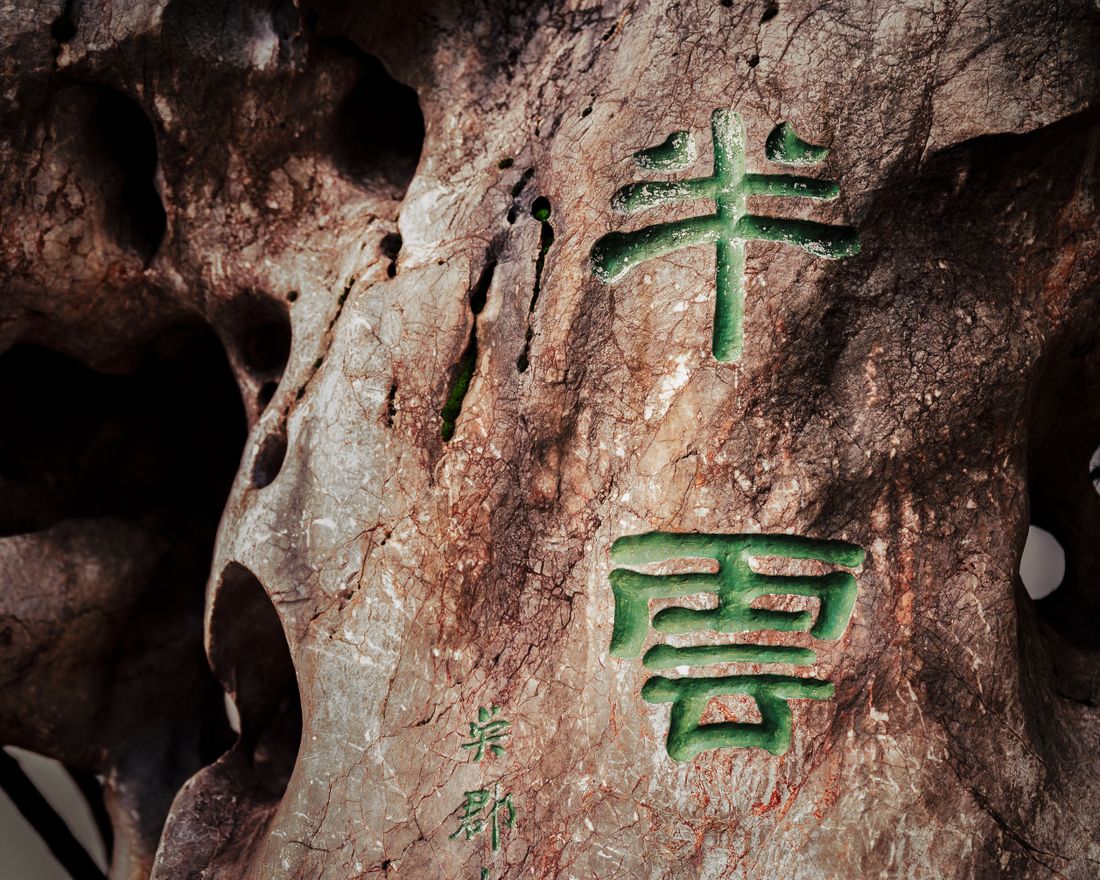
Asian and tribal art is where a confident guess costs the most. Green stone, pale carving, dark bronze and a six-character mark on the base all look like proof, and none of them is. Each can be tested with numbers that a gemologist, a conservator or a federal wildlife officer would recognize. This guide covers how jade is separated by density rather than color, how ivory is told from bone and from the law, and what bronze patina and reign marks can and cannot tell you.
What we look for
- Chinese and Japanese porcelain and pottery
- Jade, coral, and hardstone carvings
- Bronzes, netsuke, and scroll paintings
- Ethnographic and tribal pieces
Jade is a density question, not a color question
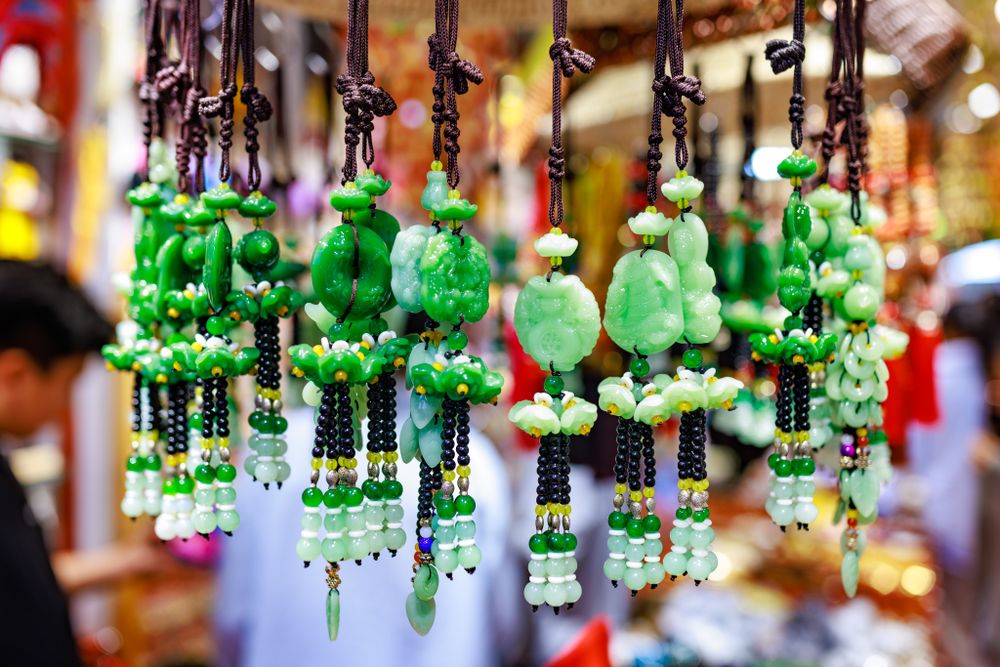
Two different minerals are sold as "jade," and a third is often passed off as one. Nephrite is a tremolite-actinolite amphibole: Mohs hardness 6–6.5, specific gravity about 2.95 (reference range roughly 2.90–3.10) and refractive index around 1.61–1.63. Jadeite is a sodium-aluminum pyroxene: hardness 6.5–7, specific gravity near 3.33 (published ranges run about 3.24–3.43) and a spot refractive index near 1.66. Serpentine, including bowenite, which the trade calls "Suzhou jade," is lighter and softer. One GIA lab note recorded a spot RI of 1.56 and an SG of about 2.56 on an antigorite cabochon.
The gap between 2.95 and 3.33 is wide enough for a simple hydrostatic test. Weigh the loose piece in air, weigh it suspended in water, then divide the air weight by the difference between the two. A jadeite bangle should feel noticeably heavy for its size, and a serpentine one noticeably light. A mounted or lacquered piece cannot be weighed this way, and the result shows the material, not the age.
Texture and polish give supporting clues. Polished jadeite is glassy (vitreous) and more granular, while nephrite looks oilier and finer-grained. Color proves nothing, because all three come in green. GIA notes that green omphacite can closely resemble fine jadeite and needs advanced testing to separate. In one instrument paper (Mendoza Cuevas and Fernandez-de-Cossio Dorta-Duque, arXiv:1610.06295), a portable X-ray diffraction and fluorescence unit was trialed on jadeite and omphacite stones, which shows how far the question goes beyond a loupe.
Material also helps with dating. Chinese jade carving is generally described as nephrite until large-scale jadeite imports from Burma arrived in the 18th century, so a jadeite piece sold as a Shang or Han antiquity is a red flag.
Ivory, bone and the federal rules a seller must respect
Elephant ivory has a signature that bone lacks. In cross-section, curved lines cross to form a lattice called the Schreger pattern. Espinoza and Mann (Journal of the American Institute for Conservation, 1993, 32(3):241–248) found that the outer angles are obtuse, above 115°, in modern elephant ivory and acute, below 90°, in woolly mammoth. Readings in between are not a clean call. The pattern also needs a transverse section, so a finished figure may offer only its base or a damaged edge. Bone shows no lattice. Look instead for Haversian canals, which appear as tiny dark pits, dots or streaks. The Western Australian Museum's conservation manual adds that chemical tests usually cannot separate bone from ivory, so a hot pin or a spot test is not a reliable answer.
The U.S. rule on African elephant ivory took effect July 6, 2016. In summary:
- Antique exception: the item must be at least 100 years old and contain a listed species. It must not have been repaired or modified with that material on or after December 28, 1973, and it must have entered through a designated port if imported. The seller must be able to prove the age.
- De minimis exception: the ivory must be a fixed or integral part, under 200 grams in total, and not the primary material of the piece (more than 50 percent of volume counts as primarily ivory). For items in the U.S., the ivory must also have been imported before January 18, 1990.
- Scope: the rule targets African elephant ivory. Asian elephants are also ESA-listed and CITES-protected, and the antique rules apply to them as well.
Florida has no statewide ban on in-state ivory sales, according to a 2023 Humane Society report. That report found suspected ivory in 20 of 46 Florida stores visited, and only two vendors claimed to have the paperwork. The same advocacy group counted 13 states with their own laws. A Broward estate sale might stay in state, but a sale to a buyer in another state brings the federal rules into play.
Reign marks and bronze patina: what the surface really says
A six-character mark such as 大明宣德年製 reads Da Ming Xuande nian zhi: "Great Ming, made in the Xuande years." It is normally set in columns read top to bottom and right to left, in regular script. The mark is a claim made by the maker, and often not the original maker. Kangxi-period blue-and-white frequently carries Ming marks, and Xuande and Chenghua are among the most copied. Some of these were homage rather than fraud. The Asian Art Museum notes that Qing imperial kilns often marked imitations with the reign of the period in which they were actually made. Bronze is no safer: Bruce Rusk's abstract on Xuande-style incense burners says their origins are uncertain, and that books purporting to authenticate them are later forgeries. Judge the body, glaze, foot and form first, and treat the mark as a footnote.
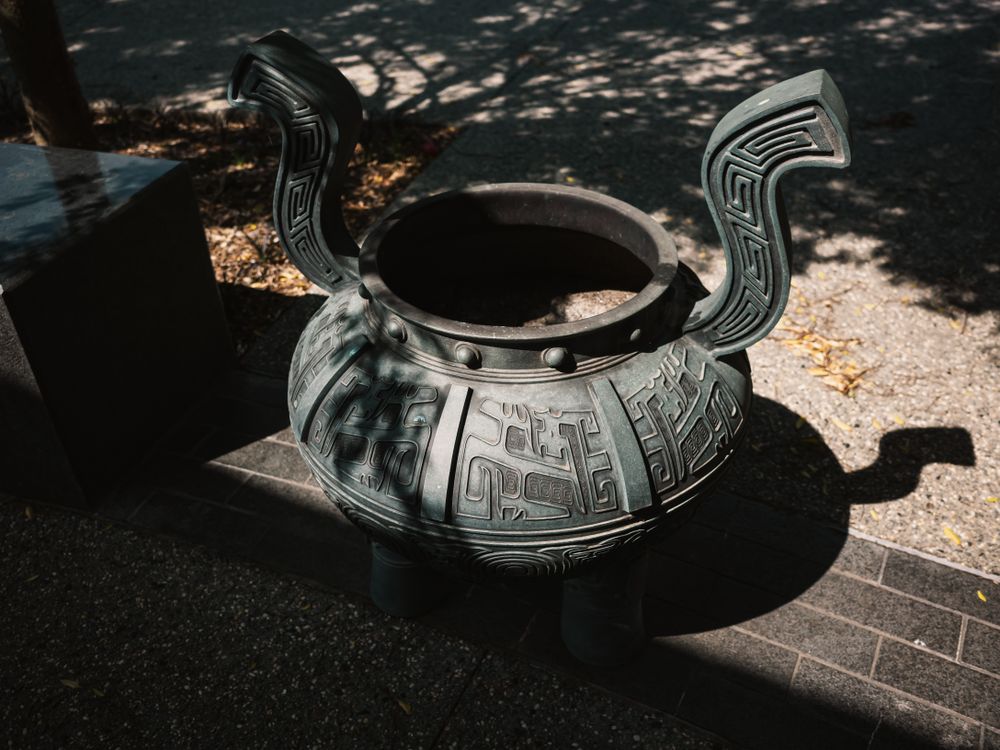
Bronze patina is chemistry you can read. Archaeological bronzes often show red cuprite under a green layer of malachite (copper hydroxy carbonate) or atacamite/paratacamite (copper hydroxychlorides, Cu2(OH)3Cl), with blue azurite in places. The danger is bronze disease. Cuprous chloride (nantokite) can sit hidden under sound-looking green, then react with moisture and oxygen to form pale green powdery trihydroxychlorides. The reaction expands the metal and can crack it.
David Scott's review (Journal of the American Institute for Conservation, 1990, 29(2):193–206) recommends storage at 42–46% relative humidity for most bronzes. He warns that above 55% the reactions become very rapid and may not stop when humidity falls again. In his tests, a compressed cuprous chloride tablet burst within a day at 70%. He also cautions that atacamite or paratacamite on the surface does not by itself prove active corrosion. Identifying the minerals reliably takes X-ray diffraction, not the eye. Do not scrub, and keep the piece dry until someone qualified has seen it.
Not sure if your piece fits? Text a photo to (561) 465-3536 — we will tell you honestly and for free, with no obligation to sell.
Questions
Selling asian & tribal art in Pompano Beach
Can I sell an old ivory carving from my Pompano Beach home?
It depends on the species, the age and your paperwork. Florida has no statewide ban on in-state sales as of 2023, but federal rules govern any sale across state lines. An African elephant piece needs to qualify as a true antique (100 years or more, unrepaired with ivory since December 28, 1973) or meet the de minimis limits. Gather receipts and photos first.
How can I tell whether my jade bangle is real before bringing it in?
Color won't settle it. If the bangle is unmounted, weigh it in air and in water to get specific gravity: about 2.95 suggests nephrite, near 3.33 suggests jadeite, and about 2.5–2.6 points to serpentine. Don't scratch it to test hardness. Bring it to us and we can talk through next steps for a Broward County seller.
My vase has a Da Ming Xuande mark. Does that mean it is Ming?
Almost never on its own. Later Chinese potters copied Ming marks for centuries, partly as homage, and Xuande is among the most copied. Whether a piece from a Pompano estate is genuinely 15th-century depends on body, glaze, foot and form. Photograph the base and foot ring clearly, and a specialist can judge them against the mark.
There is a pale green powdery crust on my bronze. Is that bronze disease?
It could be. Light green powder or small blisters can signal active chloride corrosion, which humidity speeds up. That matters in South Florida, where summer air stays damp. Keep the piece in air conditioning, away from wet rooms, and don't scrub or pick at it. A conservator can confirm the minerals with X-ray diffraction.
What paperwork should I gather if my Broward estate includes ivory?
Collect anything showing age and origin: purchase receipts, appraisals, old photos, import papers and family letters. If the piece may be an antique under the 100-year rule, the burden of proof falls on the seller. Photograph any cut surface where the Schreger pattern shows. This is general information, not legal advice, so ask an attorney about a specific piece.